
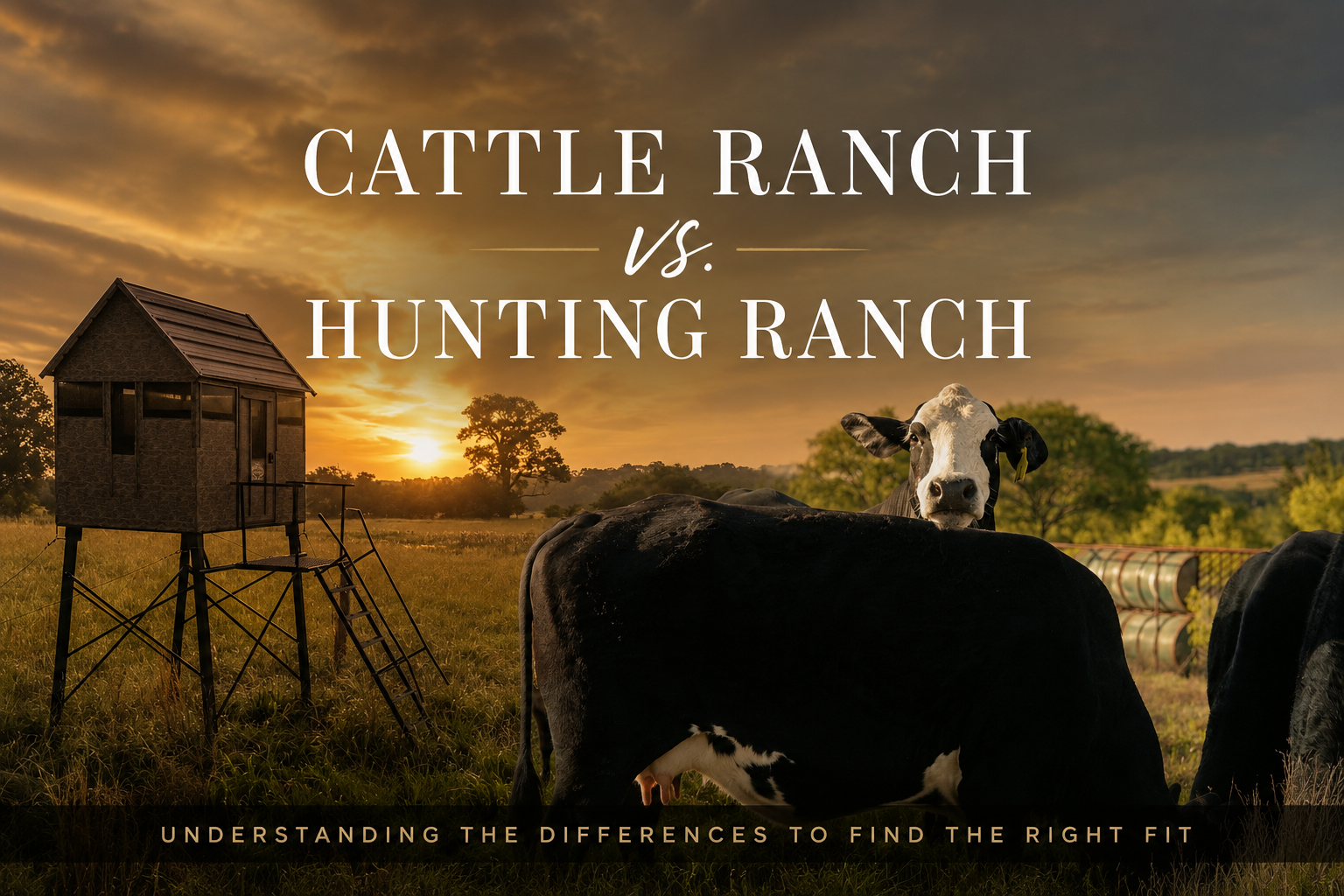
Cattle Ranch or Hunting Ranch: Which Is Right for You?
Which is better, a cattle ranch or a hunting ranch? If you’ve got 300 acres in Central Texas with good grass, some brushy draws, a seasonal creek, and enough space to do something real with it, that question is more than academic. A cow-calf operation sounds like legitimate ranching. A hunting lease sounds like passive income with a great excuse to be outdoors. Both can work. Both can also disappoint you if you pick the wrong one for your specific land, budget, and schedule.
This is not a philosophical debate about which lifestyle is more authentic. It’s a practical framework for making a decision that affects your property taxes, your weekends, your insurance coverage, and your bottom line. At Bar T Realty LLC, we work with buyers across Texas, Oklahoma, and Wyoming who ask this exact question before closing on rural land. The right answer almost always comes down to what your land can actually support, how much time you can realistically commit, and what the numbers need to look like for you.
Here is what that decision looks like when you run the numbers honestly.
What Your Land Is Already Telling You
Before you run a single financial projection, walk your land. The terrain, soil composition, water access, and vegetation structure already point toward one model more than the other. Many buyers skip this step and end up trying to force a cattle operation onto land that was built for game, or vice versa.
Cattle thrive on open grassland with slopes under 10%, loamy bottomland soils, and reliable water sources within one mile of every pasture section. Brush cover above 30% reduces grazing efficiency, and high rock content creates similar drag. Stocking rates vary significantly by region: high-rainfall areas support one to two acres per cow, while semi-arid terrain may require 10 to 20 acres per cow, and arid western land pushes above 20. The Hill Country falls somewhere in the middle, which means your per-acre carrying capacity determines how many head you can realistically run.
A hunting-focused or wildlife management ranch has almost the opposite profile. Varied topography, riparian corridors, forested drainages, native grasses mixed with forbs, and transitions between open land and brush all support game. Whitetail deer, in particular, avoid open pasture with heavy cattle presence. Properties with natural structural diversity, water features, and edge habitat hold more wildlife and command premium lease rates from serious hunters.
Minimum viable acreage also differs between a working ranch and a recreational ranch. A cattle operation needs at least 10 to 20 acres for even a small herd and scales up based on stocking rates. A hunting lease can generate meaningful income on 100 to 300 acres, and contiguous parcels above 500 acres start to support broader deer movement corridors that attract lessees willing to pay at the high end of the market, though exact acreage requirements depend on regional species density and local market demand.
Which Is Better for Your Budget: Cattle Ranch or Hunting Ranch Startup Costs
Startup costs for a small cattle operation (10 to 20 head) run between $50,000 and $100,000 when you factor in land, livestock, equipment, and insurance. For a recent breakdown of the cost to start a cattle farm, see a practical farm-level estimate that outlines typical capital needs. A medium operation of 50 to 100 head requires $150,000 to $300,000 upfront. Annual operating costs average $900 to $1,000 per cow when you combine variable costs like feed, veterinary care, and minerals with non-cash costs like depreciation and land rent. Pasture maintenance alone averages about $35 per acre.
In productive regions where stocking rates support one to two acres per cow, that translates to roughly $450 to $1,000 per acre annually in total operating costs. Equipment and ongoing infrastructure add to that figure, so it’s worth building a full cost model before you commit to a specific herd size, the LSU AgCenter basic ranching investment costs guide is a useful template for capital budgeting.
A hunting-focused property has a lower livestock capital requirement, but habitat development is not free. Food plots cost $300 to $1,600 per acre depending on whether you hire professionals or do the work yourself. On a 100-acre ranch with a five-acre minimum food plot and two or three blinds, you are looking at $11,500 to $20,500 in initial setup costs before you collect your first lease check. Add access road improvements, water feature development, and feeder infrastructure, and the number climbs further.
Legal and insurance costs are where hunting operations consistently surprise new owners. Standard farm and ranch liability policies typically exclude coverage for paying hunters on the property, a gap that catches first-time hunting ranch owners off guard and can leave them exposed to significant out-of-pocket liability. Separate hunting-lease liability insurance in Texas is strongly recommended and commonly required by insurers, typically running $300 to $1,000 or more annually depending on coverage levels. Texas also requires a specific hunting-lease license from the Texas Parks and Wildlife Department (TPWD) before you can legally charge for hunting access. Operating without it can result in misdemeanor charges, see local hunting lease resources for guidance on state requirements and best practices. These are not optional line items; they are the baseline cost of running the operation without unnecessary legal exposure.
Income Potential: What Each Model Actually Earns Per Acre
Cattle income is real but narrow. Cow-calf sales, stocker operations, direct-to-consumer beef, and supplemental grazing leases to neighboring ranchers all contribute to ranch income streams. The problem is that margins are thin, commodity prices are volatile, and many small ranchers are not generating meaningful cash flow from cattle alone. The financial case for a working cattle operation is usually built on land appreciation, ag exemption maintenance, and long-term equity rather than monthly income.
Hunting leases tell a different income story. Standard per-acre lease rates run $5 to $25 annually. On a 500-acre property, that translates to $2,500 to $12,500 per season for a straightforward, hands-off lease arrangement. In the Texas Hill Country specifically, listings cluster in the $4 to $15 per acre range, with well-managed trophy properties at the upper end. Guided and trophy hunts scale the numbers dramatically higher: elk hunts command $6,000 to $18,000 per animal, deer and antelope hunts run $2,500 to $8,000, and adding lodging as part of an agritourism model can push annual revenue well above $60,000 on the right property.
Lease rate data consistently shows hunting operations outperforming cattle grazing on a per-acre basis in high-demand regions like the Hill Country. But that premium is conditional. It requires habitat quality, healthy wildlife populations, and active land management. Cattle income is more predictable but lower per acre. The highest-earning operations tend to blend both models, using light cattle stocking to maintain grass quality while preserving enough habitat diversity to support productive hunting, grazing management practices can benefit both cattle and deer when implemented properly, as outlined in grazing management benefits cattle and deer guidance.
Time Demands: Which Is Better, a Cattle Ranch or Hunting Ranch for Your Schedule?
Cattle ranching is a year-round commitment with no real off-season. Calving season, typically in late winter and early spring, requires close attention and sometimes overnight monitoring. Daily feeding, water system checks, fencing maintenance, and herd health monitoring are non-negotiable. Drought conditions add emergency feed sourcing and supplemental water delivery to the list. If you travel frequently for work or live more than an hour from the property, a working cattle herd without hired help on-site is a problem waiting to happen.
Hunting land is not passive, but the time demands are seasonal and project-based. Prescribed burns, brush management, feeder maintenance, food plot planting, and lease administration are concentrated in specific windows throughout the year. For someone who wants meaningful engagement with the land without being tied to it seven days a week, a working ranch vs. recreational ranch comparison almost always breaks in favor of the hunting model on schedule flexibility.
The question of whether one property can serve both models has a nuanced answer. You cannot maximize cattle production and deer habitat simultaneously, one has to be prioritized. Deer actively avoid areas with heavy cattle activity and will not readily cross those zones. That said, light to moderate cattle stocking on a hunting-focused property can actually improve habitat quality by selectively reducing grass density and creating the forb growth that deer prefer. Successful dual-use ranches manage this by zoning the property and controlling cattle movement to protect hunting areas during key seasons.
Legal, Insurance, and Tax Realities That Catch Buyers Off Guard
The legal profile of a hunting operation is fundamentally different from a cattle operation, and the gaps in most buyers’ knowledge here are significant. Standard farm and ranch liability policies exclude paying hunters. Hunting ranch owners must purchase additional endorsements or a separate policy. Umbrella policies are also worth carrying given the elevated risk profile from firearms, multiple guests accessing the land, and equipment use. Without adequate coverage, a single unresolved incident can cost $5,000 to $10,000 or more out of pocket.
Every person who accesses a hunting property for a paid lease should sign a liability waiver before setting foot on the land. Leases should be detailed written contracts that specify species, bag limits, access zones, and liability terms. These are the minimum you need to run the operation without unnecessary legal exposure.
The tax angle is the piece that costs owners the most when they miss it. In Texas, hunting lease revenue is often classified as non-agricultural income. If hunting income exceeds a certain threshold relative to total ranch revenue, the property’s agricultural (1-D-1) valuation status can be reassessed, and the resulting property tax increase can be substantial. In most cases, cattle-derived revenue qualifies as agricultural income under the 1-D-1 classification, but tax treatment can vary by circumstance, verify the specifics with your county appraisal district. Owners converting from cattle to hunting need to structure their income carefully, which typically means maintaining some documented agricultural production alongside the hunting lease to protect the exemption. If you are considering this transition, consult your county appraisal district before you make the switch.
How to Choose: Cattle Ranch or Hunting Ranch
At this point, you have the data. Three questions tend to clarify which direction makes sense:
- Does your land have the open grassland, reliable water, and low brush cover that cattle require, or does it naturally favor the varied terrain and structural diversity that game species prefer?
- Do you want daily, year-round involvement in an operation, or do you prefer seasonal and project-based management that fits around your primary career or schedule?
- Is your primary financial goal steady income with long-term land equity and a secure ag exemption, or higher per-acre revenue potential with more legal setup, specialized insurance, and some additional regulatory overhead?
If your land is flat and grassy, cattle is often the natural fit, particularly if you have time to manage a herd and equity building is the long-term goal.
If your land has topographic variety and income per acre is the priority, a hunting-focused model makes more sense, especially if you want flexibility in how you spend time on the property.
If the land can support both and you are willing to manage the zoning carefully, a blended approach often earns the most and keeps the ag exemption intact.
Most buyers come to this decision with a clear vision but without a detailed picture of whether the specific property they are looking at will actually support that vision. This is where working with a specialist makes a measurable difference. At Bar T Realty LLC, we evaluate properties with exactly this kind of operational fit in mind, whether that is a working cattle spread in Central Texas, a trophy whitetail property in the Hill Country, a hunting-and-cattle dual-use ranch in Oklahoma, or a large acreage opportunity in Wyoming. For regional context and practical next steps, see our guides: Texas Vs Oklahoma | 2026 Buyer’s Guide, The Pros of purchase a ranch house in Texas, Bar T Realty, and The Perks of Owning an Oklahoma Ranch, Bar T Realty. That is the evaluation we do every day, and we will give you a straight answer before you commit to anything.
The Bottom Line: Which Is Better, a Cattle Ranch or Hunting Ranch?
There is no universally correct answer when comparing a cattle operation to a hunting-focused property. Cattle ranching offers stability, predictable income structure, and a natural path to keeping your ag exemption intact. Hunting operations offer higher income-per-acre potential and more schedule flexibility, but require more legal infrastructure, specialized insurance, and careful tax structuring. The most profitable ranches in our market often blend both, using light grazing to manage habitat while running quality hunting on the same land.
Getting that alignment right from the start is what separates a ranch that performs from one that drains resources for years before the owner figures out the mismatch. Match the model to the land, not the other way around.
If you are working through this decision for a property you already own, or you are searching for land specifically suited to one model or the other, reach out to the team at Bar T Realty LLC. This is exactly the kind of evaluation we do every day across Texas, Oklahoma, and Wyoming, and we will give you a straight answer before you sign anything.