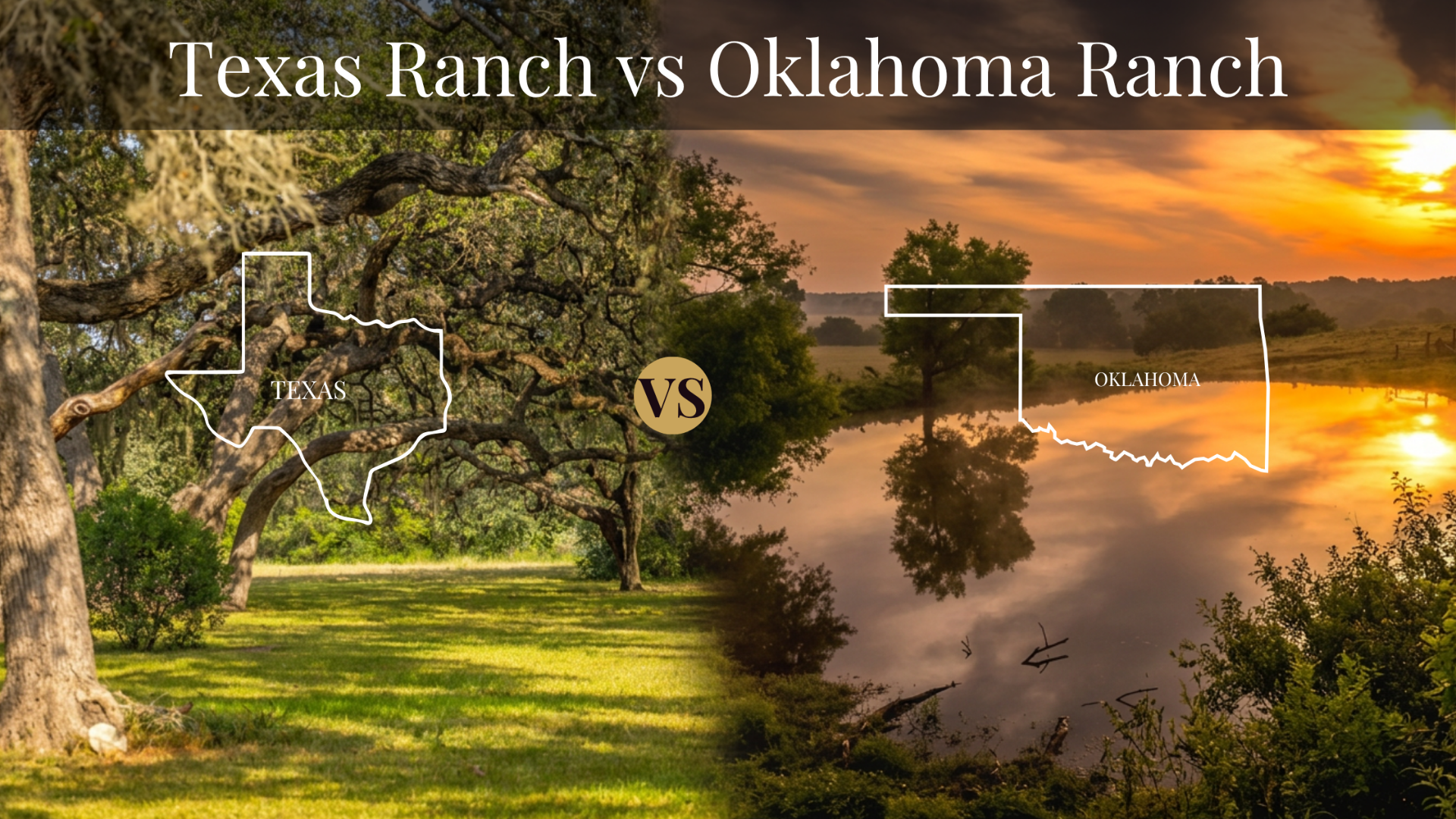
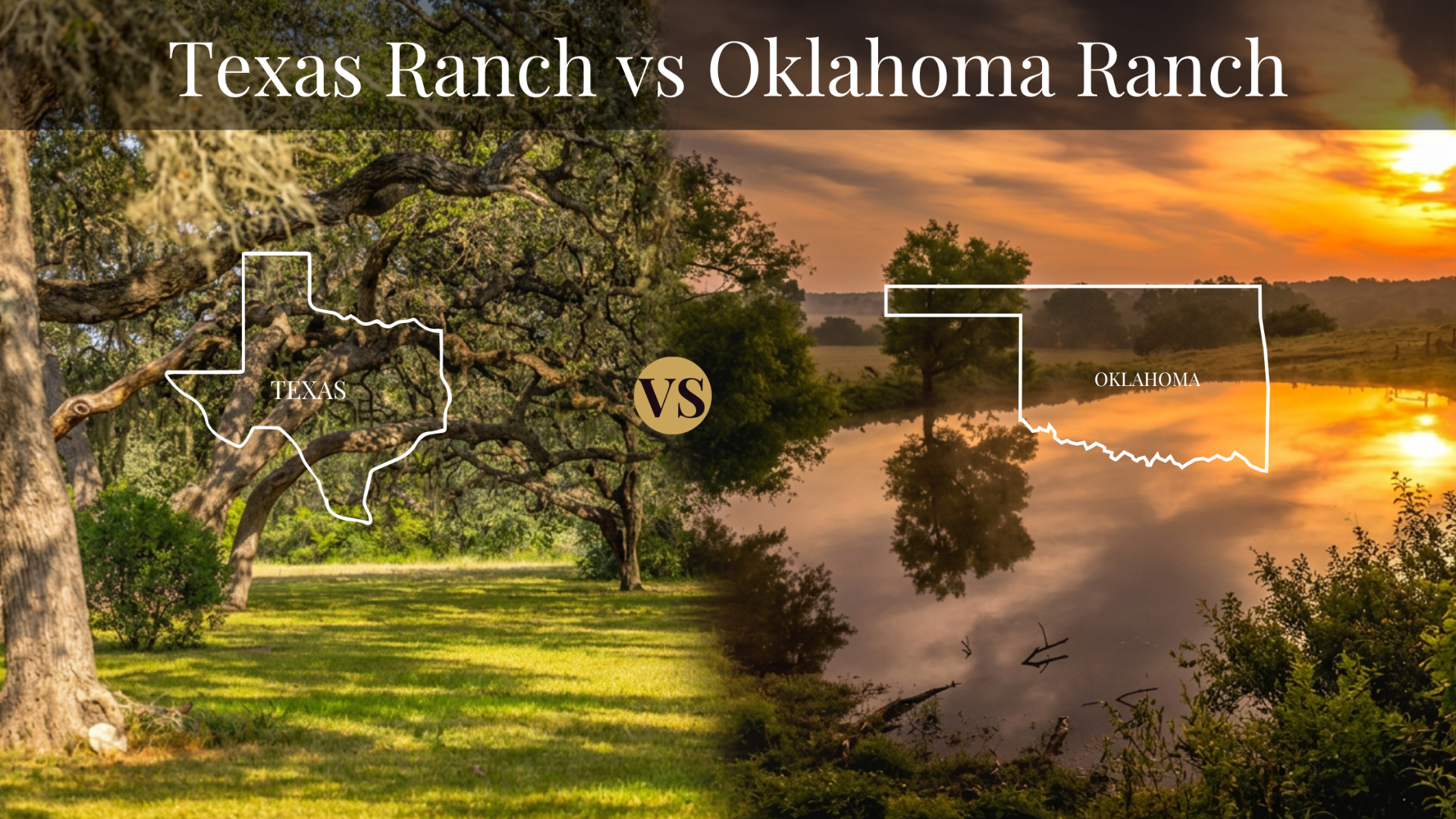
Texas vs. Oklahoma Ranch Land: The 2026 Buyer’s Guide
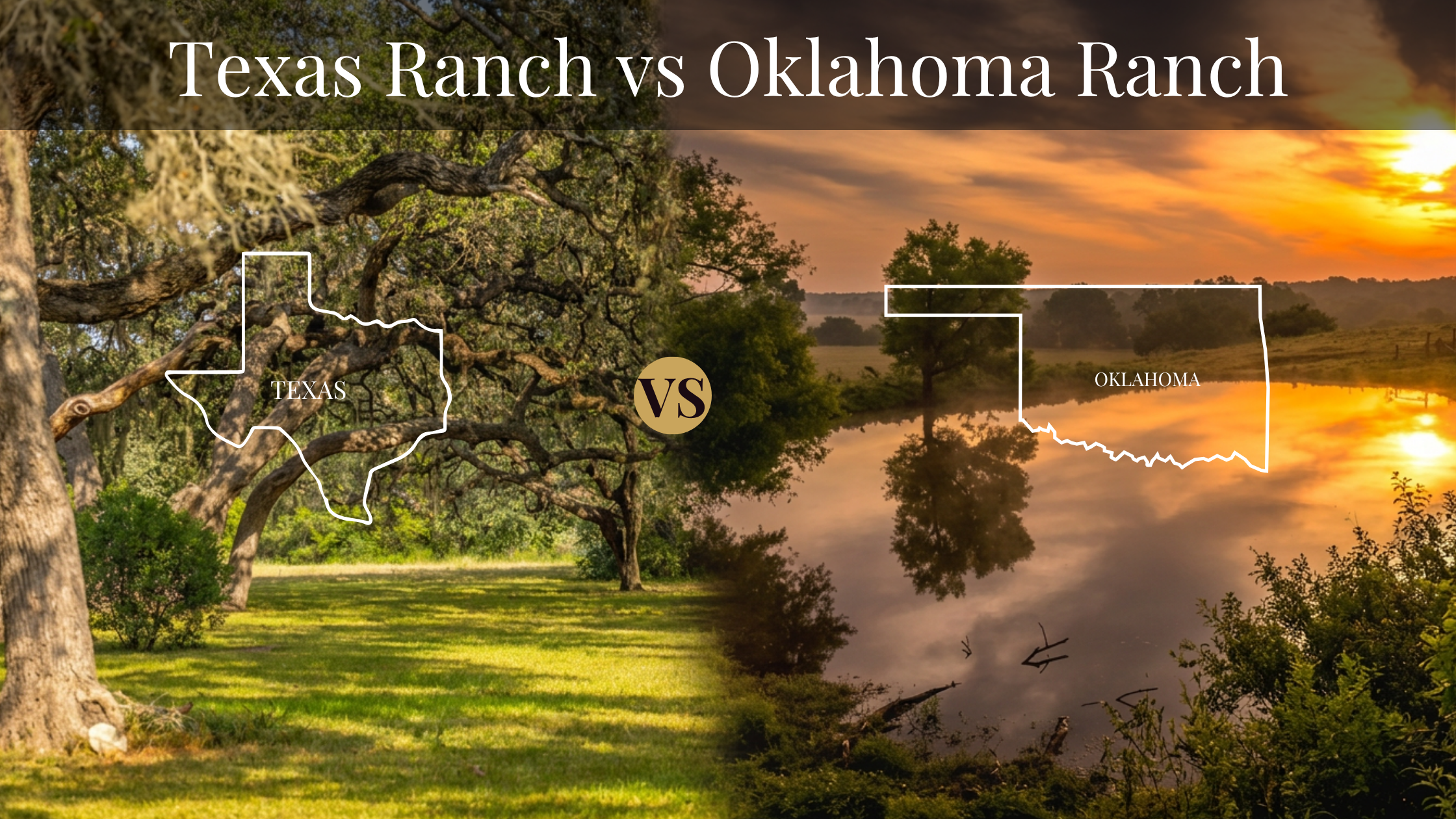
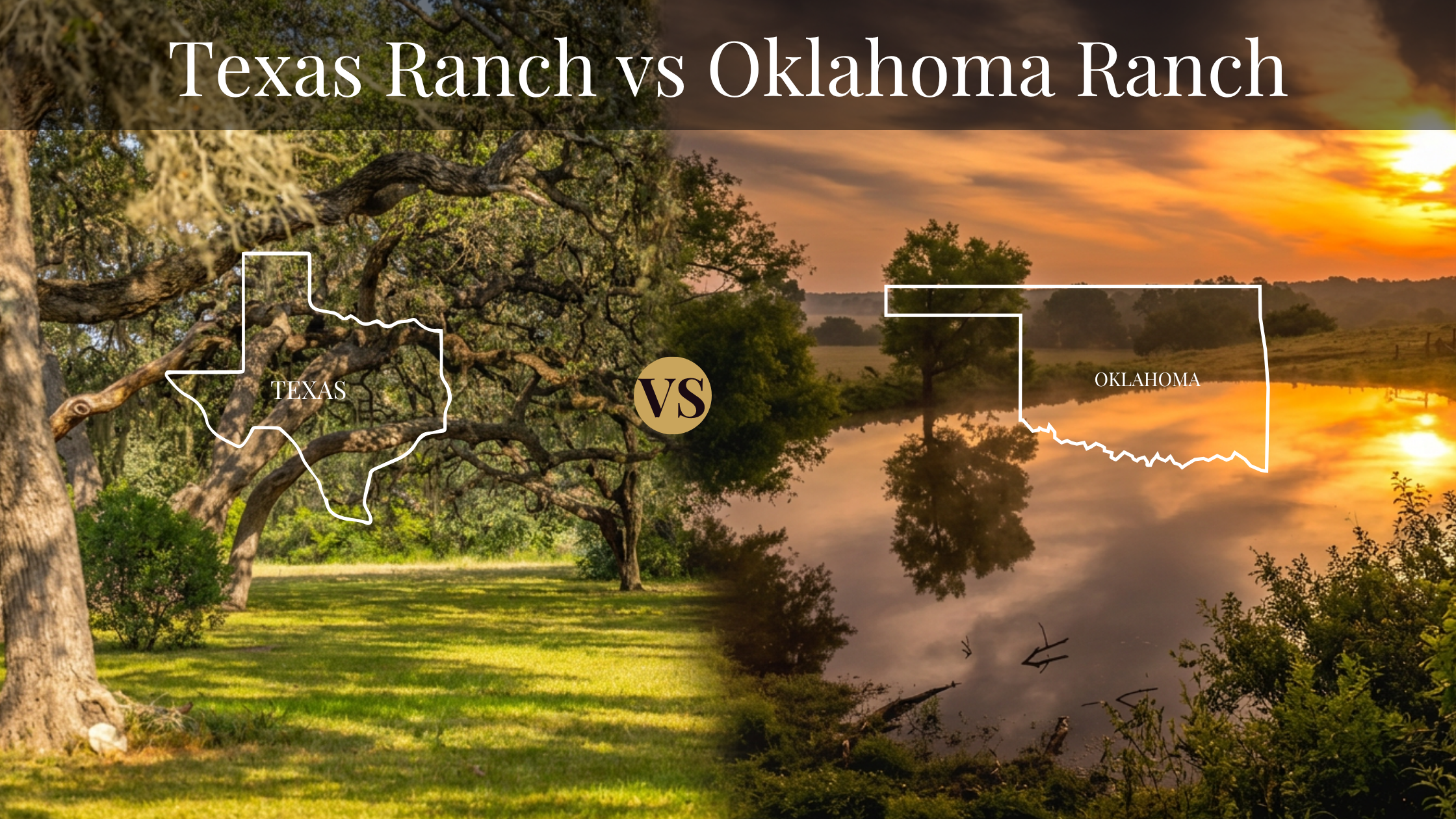
The Red River sits between Texas and Oklahoma like a line someone drew and then forgot to explain. On one side: one of the most recognizable ranch land markets in the country, with prices to match. On the other: a quieter market that regularly delivers more acres for fewer dollars. If you’re trying to buy ranch land in Texas or Oklahoma, neither choice is obviously wrong, but they’re not interchangeable either.
At Bar T Realty, that comparison is the question we hear most often from buyers. We hold active listings on both sides of that line, which lets us give buyers an honest side-by-side assessment based on their actual goals, not just whichever state has our nearest listing. With years of experience and more than $400 million in sales volume, our team has made that comparison hundreds of times. That kind of cross-state perspective is rarer than it sounds in this business.
This guide covers real 2026 price ranges, tax differences that change the annual carrying math, legal surprises that catch out-of-state buyers off guard, and a clear path to making the call. No theory. Just the information you need to choose the right state for your ranch goals.
Should You Buy Ranch in Texas or Oklahoma? The 2026 Price Breakdown
Texas first. The statewide average sits around $5,100 to $5,500 per acre, but that number is nearly useless without regional context. The Panhandle and West Texas run roughly $1,200 to $2,787 per acre. South Texas ranges from $3,000 to $7,500 per acre. The Hill Country now functions as its own market category, with prices ranging from $7,000 to $30,000 or more per acre. Northeast Texas and the Gulf Coast push $9,000 to $11,400 per acre. (See the FCA March 2026 land values update for federal-level data on recent land value trends.)
The Hill Country premium is real and still growing. If you want that Central Texas character without those prices, counties like Lampasas, Burnet, and Llano offer similar topography and water features at more accessible price points than counties sitting closer to Austin. That’s where value buyers are finding opportunities right now, and it’s our home territory at Bar T Realty.
Oklahoma tells a different story. The statewide average is approximately $2,210 per acre. Western Oklahoma raw pasture runs $800 to $1,500 per acre in many areas. Southwestern counties run roughly $1,200 to $3,000 per acre. Southeastern Oklahoma, where recreational and timber value adds a premium, runs $2,000 to $5,000 or more per acre.
Put it in concrete budget terms:
- $500K buys roughly 90 to 400 acres in Texas depending on region, or 200 to 600 acres in Oklahoma
- $1M buys 180 to 800 acres in Texas or 400 to 1,000+ acres in Oklahoma
- $2M opens up premium Texas Hill Country tracts or large working ranches in either state
If maximizing acreage per dollar is the goal, Oklahoma wins on the numbers. Whether that matters depends entirely on what you’re building. Buyers searching Texas ranch land for sale often find that Oklahoma ranch listings offer comparable production capacity at a significantly lower entry price, a trade-off worth understanding before you commit to either state.
Property Taxes, Ag Exemptions, and the Real Annual Carrying Cost
Texas has no state income tax. That’s the well-known part. What buyers consistently underestimate is that local property taxes, school district levies, county rates, and special district charges can stack up significantly on rural land. They compound annually regardless of acreage.
The offset is agricultural productivity appraisal. When your Texas ranch qualifies, it’s taxed on its productive agricultural value, not its market value. That difference can cut the annual tax bill by 70 to 90 percent. Active grazing, hay production, beekeeping, wildlife management, and orchard operations qualify. But rollback taxes matter: if the land loses its ag status, the county can recapture the tax difference for the prior five years under the 1-d-1 open-space rules.
On a high-value ranch, that liability is not small. A ranch saving $18,000 per year in taxes could face a $90,000 rollback bill if something changes.
Oklahoma carries lower property tax pressure on rural land than Texas, and use-value agricultural appraisal is also available there. For comparable acreage, annual property taxes are typically lower in Oklahoma even before any exemption applies. Combined with lower per-acre purchase prices, Oklahoma’s total carrying cost is one of its most underappreciated advantages.
Most buyers only compare purchase prices. The buyers who do the math on year-five total cost sometimes end up choosing differently than they expected.
Water Rights, Mineral Rights, and the Legal Fine Print That Surprises Buyers
Surface water in Texas is state-owned and requires permits. Groundwater operates under the rule of capture, which means landowners generally own the water beneath their land while it’s in the ground. But local Groundwater Conservation Districts add major variability.
In Lampasas County, the Saratoga Underground Water Conservation District requires wells to be registered or permitted, limits exempt wells to domestic and livestock use under 25,000 gallons per day, and can review changes in use or pumping capacity. Buying a Texas ranch with an existing well doesn’t automatically mean you can pump at will or repurpose the water for commercial use. Confirm the well’s status before you close.
For a clear legal overview of surface and groundwater rules that affect ranch purchases, consult the national water law overview.
Oklahoma takes a more state-administered approach through the Oklahoma Water Resources Board. Groundwater withdrawals are subject to permits and allocation rules. Neither state offers unlimited water access. Verify water rights, well permits, and authorized use before you make an offer, not after.
If a working water source is central to your ranch plan, make it a closing condition, not a detail to revisit later.
Mineral rights are where both states catch buyers off guard. Severed mineral estates are common in Texas and Oklahoma. The person selling you the surface may not own what’s underground. The mineral estate is legally dominant: an oil and gas operator can access the surface to produce, subject to limits.
Review at least three deeds back in the chain and understand what minerals, if any, convey with the surface. If they’re already severed, know who owns them and whether any active leases exist.
Conservation easements also run with the land permanently. If one is recorded on a property you’re considering, you’re bound by its terms regardless of what the seller tells you verbally.
Best Counties to Buy Ranch Land in Texas or Oklahoma
Your intended ranch use matters more than the state line when it comes to county selection. For cattle
operations in Texas, Deaf Smith County in the Panhandle ranks among the highest cattle-producing
counties in the state and offers working ranch economics without trophy-land pricing. Jim Hogg and
Duval counties in South Texas provide large-acreage working ranches with strong value per acre relative
to their production capacity.
For hunting in Texas, Jim Hogg and Duval also deliver: brush-country whitetail, exotic game potential, and
serious acreage at prices well below the Hill Country. Stonewall County has larger game ranch tracts
worth exploring. For buyers who want the Hill Country feel without Hill Country prices, Central Texas
counties including Lampasas, Burnet, and Llano offer live-water recreational properties at more
accessible entry points.
Oklahoma has steadily improved its hunting land profile over the past decade. Whitetail hunting in parts
of Oklahoma now competes with South Texas in value per acre, and western and southwestern Oklahoma
counties consistently deliver more land per dollar for cattle operations. The honest trade-off is
infrastructure: Oklahoma ranches often require more improvement investment than comparable Texas
properties, particularly in fencing, water systems, and road access. Factor that into your year-one budget
before comparing sticker prices.
Because Bar T Realty carries active listings in both Texas and Oklahoma, we can put a $900K Oklahoma
ranch and a $1.4M Texas ranch side by side for the same buyer and give a real comparison based on
goals, something most single-state agents simply can’t offer.
Financing When You Buy a Ranch in Texas or Oklahoma
Ranch financing is not residential mortgage lending. Expect higher down payments, different qualification criteria, and lenders who specialize in agricultural collateral. Loan terms commonly run 20 to 30 years on rural land, with amortization schedules tied to the productive life of the operation.
Knowing this before you start touring properties saves a lot of frustration.
Ranch Lenders in Texas
In Texas, the dominant specialized lenders are Capital Farm Credit, Texas Farm Credit, and AgTrust Farm Credit. All three finance rural land, working ranches, and recreational properties.
Standard down payments typically run 20 to 30 percent on land loans. Eligible Texas veterans have a real advantage here: the Texas Veterans Land Board offers land loans with as little as 5 percent down, which changes the math considerably on a $500K to $1M purchase.
Ranch Lenders in Oklahoma
In Oklahoma, Farm Credit of Western Oklahoma and regional agricultural banks are the primary specialized lenders.
USDA/FSA farm ownership direct loans were running around 5.875 percent in 2026 and can help qualifying buyers, including beginning ranchers. Seller financing is more common in Oklahoma ranch transactions than in Texas, it’s worth asking directly whether a seller is open to it.
Recreational and hunting ranches sometimes require larger down payments than income-producing cattle operations because lenders weigh the collateral differently.
Get pre-qualified with an agricultural lender before you start touring properties. Ranch sellers and their agents take pre-qualified buyers seriously. Everyone else gets passed over when a qualified offer comes in.
From Undecided to Under Contract: Your Action Plan to Buy Ranch in Texas or Oklahoma
Before you look at a single listing, answer four questions honestly:
- What’s your primary use: working cattle, hunting, recreation, investment, or lifestyle retreat?
- What’s your real budget including closing costs, year-one improvements, and annual carrying costs, not just the purchase price?
- How important is proximity to Texas metros like Austin, San Antonio, or Fort Worth?
- Are you willing to trade infrastructure quality for significantly more land?
Once you have those answers, run this due diligence checklist in order before making an offer. Don’t skip steps or reorder them.
- Confirm mineral ownership and review at least three deeds back in the chain
- Verify water rights and well permits; physically inspect all water sources on the property
- Check ag exemption current status and understand reinstatement requirements if it has lapsed
- Review any existing grazing leases, hunting leases, or conservation easements
- Get a survey confirming acreage and boundary lines
- Secure pre-qualification from an agricultural lender before submitting an offer
Most ranch brokers work one state. That’s not a criticism, it’s just how most regional brokerages are built. But it creates a built-in bias.
When you ask a Texas-only agent whether you should buy ranch land in Texas or Oklahoma, you already know what they’re going to say. The same is true in reverse.
Our “Behind the Fence” blog covers both markets with real data. Our team can put real current listings in both states in front of you and give you a straight answer based on your goals, not the nearest listing on our board.
Making the Call
Texas makes sense for buyers who value proximity to major metros, the Hill Country lifestyle, or the specific ownership framework Texas provides for water rights and ag valuation.
Oklahoma makes sense for buyers who want to buy ranch land with more acreage per dollar, lower annual carrying costs, and a market that still has room to run before it catches up to Texas pricing.
Neither answer is wrong.
The right choice depends on what you’re actually trying to build with the land, and what your real total cost looks like when you add up the purchase, the taxes, the improvements, and the annual carrying expenses honestly.
Most buyers who do that full calculation end up more confident in their decision, whichever state it points toward.
If you’re still weighing both options after reading this, that’s not a problem, it just means you need to talk to someone who knows both markets well. Reach out to Bar T Realty and we’ll compare real current ranches for sale in Texas and Oklahoma against your specific goals. One conversation usually clears up what months of research leaves open.